Gautama vs the Buddha
BY GLENN
WALLIS
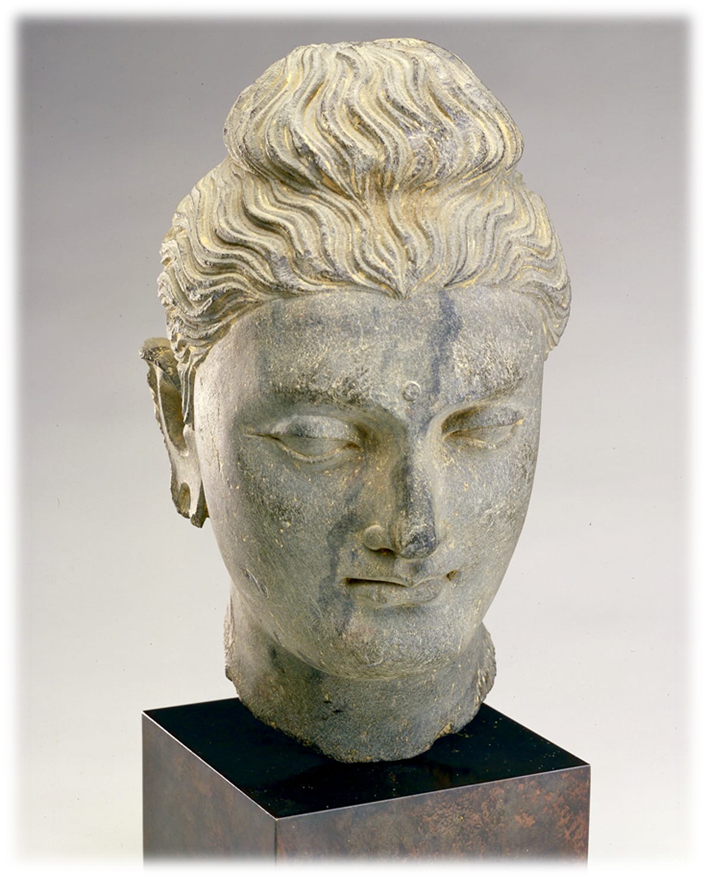
Head of a the Buddha,
circa 3rd century. Courtesy of Freer Sackler.
If you’re looking for relief from suffering,
argues Buddhist scholar and author Glenn Wallis, you won’t find it in some
mythical figure named the Buddha but in the teachings of Siddhartha
Gautama―an ordinary person like us, who became one of the world’s most
gifted spiritual teachers.
Buddhism was born in crisis. One day, the
coddled young Siddhartha Gautama found himself incapable of enjoying the pretty
things of the world. The very life that had once given him such delight now
appeared threatening. “The world, indeed, now looks to me as if ablaze with an
all-consuming fire,” he said at the outset of his epic quest for understanding
and resolution.
Gautama resolved his crisis, and in the
process, he claimed, he discovered something significant about dealing with
life’s difficulties. Two classical dialogues, or sutras, recorded in the Pali
canon help to illuminate this discovery. The sutras are called “Quenched” and
“Destination.”
Before I turn to these sutras as fitting
responses to our own difficult times, I want to explain why I call the speaker
of the text “Gautama” (Gotama in Pali), rather than “the Buddha.” The short
answer is that I agree with Ralph Waldo Emerson that our life-guides “must be
related to us, and our life receive from [them] some promise of explanation.”
Gautama fulfills this basic requirement. The Buddha does not.
I have given up on the Buddha. That is to say,
I have given up on the Enlightened One, the Blessed One, the omniscient Lord of
people and gods who works miracles, knows unknowable things, and continues to
exert his power from beyond. When I ask Buddhists to explain why I should
accept their revered sage as a modern-day life-adviser, I am typically offered
only articles of faith (claims to be believed in or rejected) and rarely good
(that is, examinable and testable) reasons.
I imagine that some readers are like me in this
regard: we have been inoculated against the religious bug. We are no longer
willing, or even able, to acquiesce to the inscrutable sureness of the
religious authorities’ advice concerning the most important matters of life and
death. Like the Kalamas in ancient India, living at a
crossroads of competing religious–philosophic commerce, we have eyes only for
what lies in full view. And what lies in view is the merit of a claim, not its
sacred origins in some cosmic or cognitive transcendence, such as
“enlightenment.”
But along the way, something unexpected
happened. I met one of the world’s most gifted teachers. He is Gautama, the
human figure behind the fanciful facade of the Buddha. Like the Stoics,
Epicureans, and Platonists in ancient Greece and Rome, Gautama instructed in
the manner of a philosopher, a lover of wisdom. He taught and modeled a viable
way to human flourishing, and did so rooted firmly in everyday life. With
precision, care, and intelligence, Gautama articulated for us the categories
and practices through which we may clearly understand our lives and, doing so, know for ourselves the simple happiness of existing, in
difficult as well as trouble-free times. And all of his advice on these matters
stands in full view―conspicuous, open to scrutiny, testable.
SIGN UP FOR LION’S
ROAR NEWSLETTERS
Get even more Buddhist wisdom delivered
straight to your inbox! Sign up for Lion’s Roar free email newsletters.

Now, as Gautama would say, don’t take my word
on any of this. It is better that you consider an actual example. So, let’s
return now to our sutras, “Quenched” and “Destination.” They happen
to contain wonderful advice for dealing with difficulties. At least, that is
what I discovered when I put these instructions to the test.
Quenched
Once, a man called Janussoni
approached the Fortunate One. Exchanging greetings, he sat down next to the
Fortunate One, and spoke.
“It is said, ‘unbinding is conspicuous,
unbinding is conspicuous.’ In what regard, friend Gotama, is unbinding
conspicuous? In what regard is it palpable, leading the practitioner to come
and see, and to be personally realized by the wise?”
Gotama replied, “Janussoni,
an infatuated, hostile, and deluded person comes to the realization that,
through the overwhelming power of infatuation, hostility, and delusion he has
become mentally exhausted, and that he is hurting himself and others. And that
person becomes depressed and distressed. He realizes that if infatuation,
hostility, and delusion were eradicated he would no longer hurt himself, he
would no longer hurt others, and he would no longer experience depression and
distress. It is in this way, Janussoni, that
unbinding is conspicuous. Because a person realizes the absolute eradication of
infatuation, the absolute eradication of hostility, and the absolute
eradication of delusion, unbinding is conspicuous, palpable, leading the
practitioner to come and see, and to be personally realized by the
wise.”
―Nibbuta
Sutta; Anguttaranikaya 3.55
Whenever I read this sutra, I am struck by its
tone. It sounds genuine. I don’t hear anything resembling art or literature or
religion in the words being exchanged. I’m not sure why, but I get the
impression that Gautama is an old man here. I hear him speaking with the
practiced combination of tenderness and terseness unique to someone who has
expressed this teaching in so many ways in such detail to so many people for so
long. Janussoni’s question is simple and direct, and
Gautama sees that Janussoni’s concern is real. It’s a
genuine question calling for a genuine answer.
I suspect, though, that Janussoni
was not a student of Gautama. If he was, I think that Gautama might have had a
word or two more to say about method. Our second sutra helps fill this gap. In
it, Gautama is speaking to a group of followers, which probably accounts for
the nature of his additional comments.
Destination
I will teach the destination and the path
leading to the destination. Listen to what I say. What is the destination? The
eradication of infatuation, the eradication of hostility, and the eradication
of delusion is what is called the destination. And what is the path leading to
the destination? Present-moment awareness directed toward the body. This
awareness is what is called the path leading to the destination.
In this way, I have taught to you the
destination and the path leading to the destination. That which should be done
out of compassion by a caring teacher who desires the welfare of his students,
I have done for you.
There are secluded places. Meditate, do not be
negligent! Don’t have regrets later! This is my instruction to you.
―Parayana
Sutta; Samyuttanikaya 4.43.44.
The structure of Gautama’s answers in both
sutras reflects simultaneously the no-nonsense nature of the exchanges as well
as the content of the advice being offered. The exchanges and the advice are
sparse and elegant, in the way that physicists like their theories to be.
On the face of it, the instruction that Gautama
offers to Janussoni and his students might seem
predictable, perhaps even somewhat trivial. The more I reflect on it, however,
the more it strikes me as a remarkably poignant response to our situation as
human beings in a deeply troubled world.
As the titles “Quenched” and “Destination”
indicate, Gautama’s advice points directly to the very purpose of his
teachings: nirvana. Gautama dedicated his life to developing and prescribing a
realistic treatment for human unhappiness. He observed that people spend their
lives caught in a whirlwind of activity that harms others and is
self-defeating. He termed this tumult samsara, and contrasted it with nirvana,
a condition of release. Nirvana is the cool forest, a refreshing breeze, a
thirst quenched. Samsara is burning sensation, overheated dizziness, confusion,
and difficulty.
Why do we persist in creating such samsaric difficulty for ourselves and others? Gautama’s
inquiry into the nature and cause of our continuing unhappiness involved a
painstaking examination of the processes that, he would come to see, constitute
“human being” (as both noun and verb); namely, those of body, feeling, mind,
and sensory reception. It is in these “four locations,” he would discover, that
each of us fashions our particular subjective experience of “the world.”
Gautama wanted to alert us to the character of these processes; so, his
teachings on human well-being deal largely with what unfolds in the four areas,
such as perception, conception, desire, pleasure, grasping, awareness,
causation, absence of self, and non-substantiality.
But Gautama was not merely interested in
a description of the processes and compulsions of humans. His
ultimate concern was a prescription―providing recommendations
for what to do in the face of these processes and compulsions. Gautama’s own
shorthand for describing the aim of his teaching project was simply this: pain
and its ending.
So, getting to the point means getting clear
about nirvana. Probably most of us would agree, however, that nirvana is a
pretty fuzzy notion. What does it refer to? For the casual listener of his day,
nirvana would have been understood as referring to an extraordinary state of
affairs, such as transcendence, salvation, or even something like heaven.
Perhaps both to disarm and reorient his listeners from their pious acceptance
of extravagant religious terminology, Gautama gave nirvana lots of nicknames. He
called it, for instance: the far shore, the subtle, the unproliferated,
the peaceful, the wonderful, freedom, the island, the shelter, the asylum, the
refuge.
Glosses like these can help us come closer to a
doctrinally responsible English translation of nirvana. What are they saying?
What do they point to? Of all the candidates, one translation stands out as
being particularly apt: “unbinding.” Most of the nirvana translations and
glosses are adjectives or nouns, describing qualities or positing places and
things. “Unbinding” has an advantage over these terms in that it implies a
process. It is in a vibrant form, allowing, like a present progressive verb, a
sense of a continuous, developing, or imminent action. In short, “unbinding”
has a dynamism lacking in most other translations. Most important, of course,
it performs exceptionally well the task given it in Gautama’s overall scheme.
This idea of unbinding fits well with what
Gautama is telling his students and Janussoni.
Gautama shows that he understands our everyday difficulty―our mental
exhaustion, depression, distress, the ways in which we harm ourselves and
others. He has identified a plausible basis for our “difficulty consciousness”
and laid it open to our scrutiny; namely, that we allow ourselves to be
overwhelmed by the “power of infatuation, hostility, and delusion.”
Infatuation, hostility, and delusion are fueling our difficulty. For one who
realizes this, Gautama tells Janussoni, unbinding―nirvana―has been
made “conspicuous, palpable, leading the practitioner to come and see.”
Can Gautama really be equating nirvana with the
eradication of infatuation, hostility, and delusion? The effects of such
eradication certainly would be in full view to you and to all of those whom
your life touches. Right?
Taken together, infatuation, hostility, and
delusion are referred to as klesha―stain,
defilement, soiling. The term stems from the verbal root klish, meaning “to torment, to trouble, to cause
unease.” And it certainly is not difficult to see that the presence of
infatuation, hostility, or delusion in any given instance of experience tends
to spoil things.
This points to a crucial feature of the kleshas. Each of these qualities lies on a continuum of
ordinary human responses to any given event, person, or phenomenon. Infatuation
lies on a continuum extending from virtually imperceptible attraction to
enjoyment to raging lust; hostility, from preconscious aversion to umbrage to
violent hatred; delusion, from automatic, unconscious perceptual assumptions to
open-minded uncertainty to schizophrenic-like hallucination. Infatuation,
hostility, and delusion, then, can be understood as the points where the flavor
so vital to a fulfilling life turns sour and becomes toxic. But how will you
know when your response has slipped into the toxic?
Could Gautama’s answer be any simpler? Just
observe for yourself, he tells Janussoni, the role played by infatuation,
hostility, and delusion in your life. Notice how these qualities leave you
exhausted and depressed. Notice the distress they create for you and others.
Now, diminish their role―unbind yourself from their influence―and
observe what happens. See the difference? It is in this way, Janussoni, that unbinding is conspicuous.
To his students, Gautama is even more specific.
He tells them that the path to conspicuous unbinding is “present-moment
awareness directed toward the body.” Elsewhere, Gautama emphasized that it was
“within this six-foot body, with its mind and its concepts” that he became
awakened. I have always understood this statement as pointing to the basic
humanity of Gautama’s message. In that regard, we can see it as a warning and a
reminder. It warns us to check our tendency to elevate certain humans to an exclusive,
even deified, status. If we do so, then what prospects do we have?
And therein lies the reminder: now, bringing clear and present awareness to
your body and all that that entails (namely, everything!), how is it with you?
Is infatuation present? Have you unbound from its toxic compulsion? Where, if
not there, in your body, can the answer be found?
Gautama’s advice to attend closely to our
bodies for direct evidence of our condition stems, of course, from an axiom
that he holds: we are estranged from ourselves. Thus, estranged, we are
constantly battered by, well, infatuation, hostility, and delusion. What can we
do about that? Here, Gautama pushes his students further than Janussoni, and
challenges them to really do what it takes: meditate.
In Gautama’s view, we are never free from
difficulty. Really, the first noble truth could be translated as “life is
difficulty.” Given that premise, Gautama’s teachings always show us how to
create ease for ourselves in the midst of this tense, difficult world. And his
prescribed method, meditation, enables us slowly to unbind ourselves from the
trouble-making effects of infatuation, hostility, and delusion. If we take
Gautama’s word that each of his teachings contains the flavor of the whole
― as every drop of the ocean’s water contains the taste of salt ―
then it might not be an exaggeration to claim that “Quenched” and “Destination”
are saturated with the whole of his dharma.
In one of the most moving passages in all of
the massive canons of Buddhist literature, none stirs me as much these final
words of our sutra “Destination”:
In this way, I have taught to you the
destination and the path leading to the destination. That which should be done
out of compassion by a caring teacher who desires the welfare of his students,
I have done for you.
There are secluded places. Meditate, do not be
negligent! Don’t have regrets later! This is my instruction to you.
After all, what more can a teacher say?