The Magic Moment
Sharon Salzberg explains how to practice basic
breath meditation.
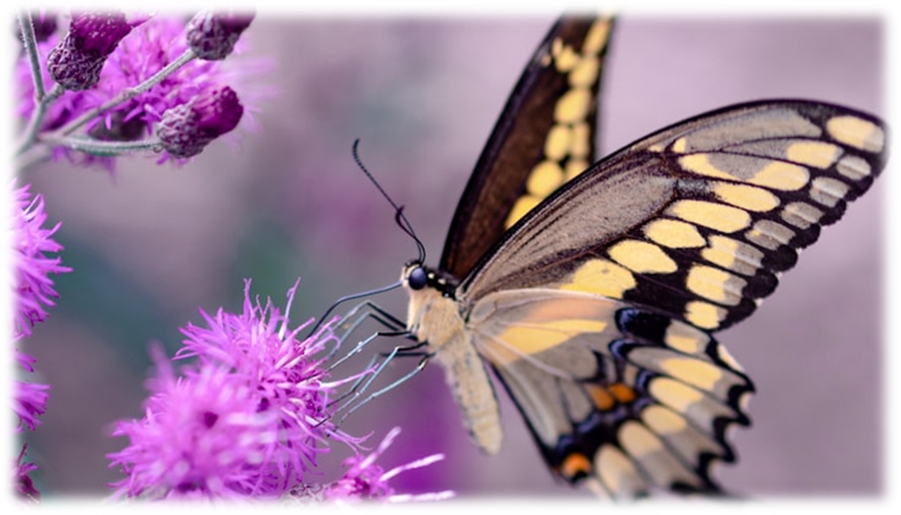
“Rest your attention lightly—as lightly as a
butterfly rests on a flower.” Photo by Aaron Burden.
This classic meditation practice is designed to
deepen concentration by teaching us to focus on the in-breath and out-breath.
Sit comfortably on a cushion or a chair. Keep
your back erect, but without straining or overarching. (If you can’t sit, lie
on your back, on a yoga mat or folded blanket, with your arms at your sides.)
Close your eyes, if you’re comfortable with
that. If not, gaze gently a few feet in front of you. Aim for a state of alert
relaxation.
Deliberately take three or four deep breaths,
feeling the air as it enters your nostrils, fills your chest and abdomen, and
flows out again. Then let your breathing settle into its natural rhythm,
without forcing or controlling it. Just feel the breath as it happens, without
trying to change it or improve it. You’re breathing anyway. All you have to do
is feel it.
Notice where you feel your breath most vividly.
Perhaps it’s predominant at the nostrils, perhaps at the chest or abdomen. Then
rest your attention lightly—as lightly as a butterfly rests on a flower—on just
that area.
Become aware of sensations there. If you’re
focusing on the breath at the nostrils, for example, you may experience
tingling, vibration, or warmth, itchiness. You may observe that the breath is
cooler when it comes in through the nostrils and warmer when it goes out. If
you’re focusing on the breath at the abdomen, you may feel movement, pressure,
stretching, release. You don’t need to name these sensations—simply feel them.
SIGN UP FOR LION’S
ROAR NEWSLETTERS
Get even more Buddhist wisdom delivered
straight to your inbox! Sign up for Lion’s Roar free email newsletters.

Let your attention rest on the feeling of the
natural breath, one breath at a time. (Notice how often the word “rest” comes
up in this instruction? This is a very restful practice.) You don’t need to
change it, force it, or “do it right”: just feel it. You don’t need to make the
breath deeper or longer or different from the way it is. Simply be aware of it,
one breath at a time.
You may find that the rhythm of your breathing
changes. Just allow it to be however it is. Sometimes people get a little
self-conscious, almost panicky, about watching themselves breathe—they start
hyperventilating a little, or holding their breath without fully realizing what
they’re doing. If that happens, just breathe more gently. To help support your
awareness of the breath, you might want to experiment with silently saying to
yourself “in” with each inhalation and “out” with each exhalation, or perhaps
“rising” and “falling.” But make this mental note very quietly within, so that
you don’t disrupt your concentration on the sensations of the breath.
Connecting to your breath when thoughts or
images arise is like spotting a friend in a crowd: You don’t have to shove
everyone else aside or order them to go away; you just direct your attention,
your enthusiasm, your interest toward your friend.
Many distractions will arise—thoughts, images,
emotions, aches, pains, plans. Just be with your breath and let them go. You
don’t need to chase after them, you don’t need to hang onto them, you don’t
need to analyze them. You’re just breathing. Connecting to your breath when
thoughts or images arise is like spotting a friend in a crowd: You don’t have
to shove everyone else aside or order them to go away; you just direct your
attention, your enthusiasm, your interest toward your friend. “Oh,” you think,
“there’s my friend in that crowd. Oh, there’s my breath, among those thoughts
and feelings and sensations.” If distractions arise that are strong enough to
take your attention away from the feeling of the breath—physical sensations,
emotions, memories, plans, an incredible fantasy, a pressing list of chores,
whatever it might be—or if you find that you’ve dozed off, don’t be concerned.
See if you can let go of any distractions and return your attention to the
feeling of the breath.
Once you’ve noticed whatever has captured your
attention, you don’t have to do anything about it. Just be aware of it without
adding anything to it—without tacking on judgment (“I fell asleep! What an
idiot!”); without interpretation (“I’m terrible at meditation!”); without
comparisons (“Probably everyone can stay with the breath longer than I can!” or
“I should be thinking better thoughts!”); without projections into the future
(“What if this thought irritates me so much I can’t get back to concentrating on
my breath? I’m going to be annoyed for the rest of my life! I’m never going to
learn how to meditate!”).
You don’t have to get mad at yourself for
having a thought. You don’t have to evaluate its content, just acknowledge it.
You’re not elaborating on the thought or feeling. You’re not judging it. You’re
neither struggling against it nor falling into its embrace and getting swept
away by it. When you notice your mind is not on your breath, notice what is on
your mind. And then, no matter what it is, let go of it. Come back to focusing
on your nostrils or your abdomen or wherever you feel your breath.
Rather than tell yourself you’re weak or
undisciplined, or give up in frustration, simply let go and begin again.
The moment you realize you’ve been distracted
is the magic moment. It’s a chance to be really different, to try a new
response. Rather than tell yourself you’re weak or undisciplined, or give up in
frustration, simply let go and begin again. In fact, instead of chastising
yourself, you might thank yourself for recognizing that you’ve been distracted,
and for returning to your breath. This act of beginning again is the essential
art of the meditation practice.
Every time you find yourself speculating about
the future, replaying the past, or getting wrapped up in self-criticism,
shepherd your attention back to the actual sensations of the breath. If it
helps restore concentration, mentally say “in” and “out” with each breath, as
suggested earlier.) Our practice is to let go gently and return to focusing on
the breath. Note the word “gently.” We gently acknowledge and release
distractions, and gently forgive ourselves for having wandered. With great
kindness to ourselves, we once more return our attention to the breath.
If you have to let go of distractions and begin
again thousands of times, fine. That’s not a roadblock to the practice—that is
the practice. That’s life: starting over, one breath at a time.
If you feel sleepy, sit up straighter, open
your eyes if they’re closed, take a few deep breaths, and then return to
breathing naturally. You don’t need to control the breath or make it different
from the way it is. Simply be with it. Feel the beginning of the in-breath and
the end of it; the beginning of the out-breath and the end of it. Feel the
little pause at the beginning and end of each breath.
Continue following your breath—and starting
over when you’re distracted—until you’ve come to the end of the time period
you’ve set aside for meditation. When you’re ready, open your eyes or lift your
gaze.
Try to bring some of the qualities of
concentration you just experienced—presence, calm observation, willingness to
start over, and gentleness—to the next activity that you perform at home, at
work, among friends, or among strangers.
Excerpted from Real Happiness: The Power of
Meditation—A 28-Day Program by Sharon Salzberg. © Sharon Salzberg, 2011. Used
by permission of Workman Publishing Co., Inc., New York. All rights reserved.