The Message of the Buddha’s Four Noble Truths
BY SYLVIA BOORSTEIN|
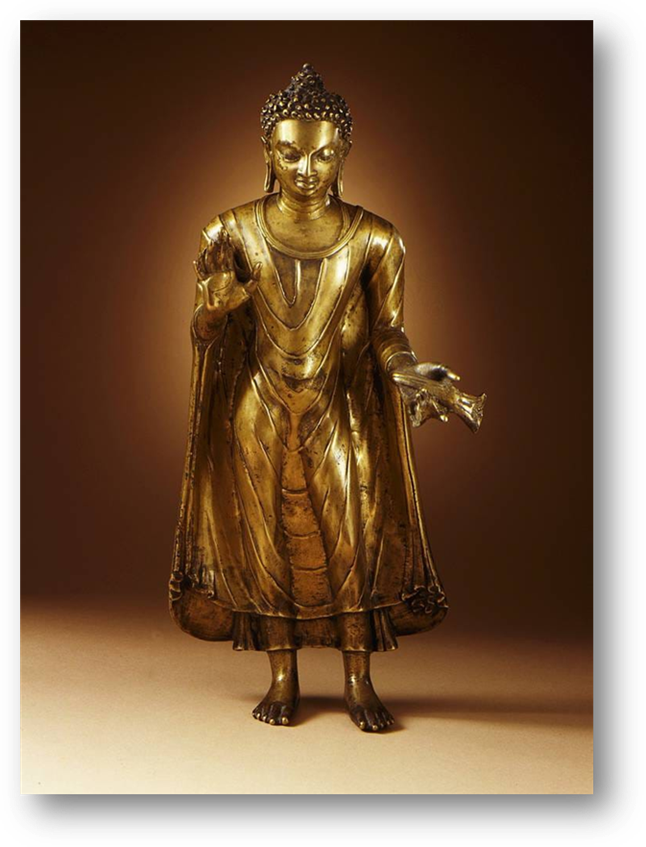 Buddha Shakyamuni. India, Uttar Pradesh, late
6th century. Copper alloy sculpture with traces of paint. Via LACMA.
Buddha Shakyamuni. India, Uttar Pradesh, late
6th century. Copper alloy sculpture with traces of paint. Via LACMA.
The message of Buddha’s Four Noble Truths is
that paying attention and seeing clearly lead to behaving impeccably in every
moment, out of love, and on behalf of all beings.
The Buddha’s First
Teaching
Accounts of the Buddha’s life, said to have
been told by generations of disciples before they were written down and
codified as scripture, often begin with the words, “Thus I have heard,” which
carry the sense of oral tradition into the present. The teacher-to-student,
elder-to-novice tone of the narratives invites us into a centuries-old
community of storytellers who made the Buddha’s practice their own practice. We
are in the line of people who have heard the story.
The sermon called “Setting into Motion the
Wheel of Truth” is the account of the Buddha’s first formal teaching after he
declared his enlightenment, his experience of deeply understanding both the
cause of and the remedy for suffering. It includes, before the Buddha’s
statement of the Four Noble Truths as the summary of his insight, the fact that
he gave this teaching to five monks he met walking near Benares. A story told
about that encounter describes how the five monks, recognizing the Buddha from
afar as the person who had formerly done ascetic practice with them, said
disparaging things to each other about him.
As one account has it: “They agreed among
themselves, ‘Here comes the monk Gautama, who became self-indulgent, gave up
the struggle and reverted to luxury,’ ” and only
reluctantly agreed to listen to him. That same account describes how at the end
of the Buddha’s teaching, as one after another of the monks understood the
truth of what he had said, “the news traveled right up to the Brahma world.
This ten-thousand-fold world-element shook and quaked and trembled while a
great measureless light surpassing the splendor of the gods appeared in the
world.”
The stories my friends and I tell each other
about our experience of hearing the Four Noble Truths for the first time
resemble, though in twenty-first-century English-language idiom, the account of
what happened in Benares. My view that I was stuck forever with my worrying,
fearful, often sorrowful mind-the victim of whatever events my life had in
store for me-“shook and quaked” at the news that a
liberated mind, a mind at ease in wisdom and filled with compassion, was a
possibility. Long before I had any confidence that I would be able to see
clearly, it was thrilling just to know that it was possible for human
beings-like the Buddha, who was a human being-to become, through practice, free
of suffering.
Teaching the Four
Noble Truths
When I teach the Four Noble Truths, I say them
this way:
I.
Life is challenging. For everyone. Our physical
bodies, our relationships-all of our life circumstances-are fragile and subject
to change. We are always accommodating.
SIGN UP FOR LION’S
ROAR NEWSLETTERS
Get even more Buddhist wisdom delivered
straight to your inbox! Sign up for Lion’s Roar free email newsletters.

II.
The cause of suffering is the mind’s struggle
in response to challenge.
III.
The end of suffering-a non-struggling, peaceful
mind-is a possibility.
IV.
The program for ending suffering is the
Eightfold Path. It is:
1. Wise Understanding: realizing the cause of
suffering;
2. Wise Intention: motivation to end suffering;
3. Wise Speech: speaking in a way that
cultivates clarity;
4. Wise Action: behaving in ways that maintain
clarity;
5. Wise Livelihood: supporting oneself in a
wholesome way;
6. Wise Effort: cultivating skillful (peaceful)
mind habits;
7. Wise Concentration: cultivating a steady,
focused, ease-filled mind;
8. Wise Mindfulness: cultivating alert,
balanced attention.
Each time I teach the Four Noble Truths I
re-inspire myself. They make so much sense. Every step of the practice path is
an ordinary, everyday activity of human beings. I say, “Look what a feedback
loop this is! It’s a never-ending, self-supporting system. Any piece of it
builds all the other parts. The more we understand the causes of suffering, the
greater our intention; the wiser and more compassionate our behavior, the
clearer our minds; the deeper our understanding of suffering, the stronger our
intention; over and over and on and on.”
When we see clearly, we behave impeccably, out
of love, on behalf of all beings.
I especially like to teach the steps in this 1
through 8 progression, because I always want to pause and emphasize Wise
Mindfulness. It reaffirms for me the goal of practice. Paying attention, seeing
clearly in every moment, leads—by way of insight—to appropriate response.
I sometimes end a Four Noble Truths teaching by
saying, “That was a lot of words. But truly, what the Buddha taught was simple:
When we see clearly, we behave impeccably.” If I want to be sure that I’ve made
the point that acting wisely and compassionately is the inevitable, passionate
imperative of the heart that comes from realizing the depth of suffering in the
world—that we pay attention for goodness’ sake—I say it this way: “When we see
clearly, we behave impeccably, out of love, on behalf of all beings.”
The Present Moment
Until quite recently, no one ever challenged me
when I said that the Buddha said, “We ought to practice as if our hair is on
fire.” I thought it was a good metaphor for the energy level needed to meet the
lifelong challenge of keeping the mind clear, remembering what’s important,
refining the capacity of the heart for goodness. Then a young woman came to see
me during lunchtime at a daylong mindfulness workshop. She said, “That’s an
awful image. It’s so frantic.” She reminded me that Thich Nhat Hanh says, “Life
is so short, we should all move more slowly.”
When I taught again in the afternoon, I went
back to the hair-on-fire metaphor and suggested that I thought it had to do
with urgency and not alarm. I told the group how inspired I had been when one
of my teachers—describing how easily we are caught up in rehearsing for the
future or ruminating over the past, all the while not awake to present
experience, not choosing wisely—had said, “It’s your life. Don’t miss it!” I
wanted to tell a story about what being awake to present experience means, and
immediately thought of a famous one from the Zen tradition.
A tiger gave chase to a monk who had been
walking peacefully near a cliff, and the monk, running as fast as he could, had
no choice but to leap off the edge of the cliff to avoid being eaten. He was
able, as he leapt, to grab hold of a vine trailing over the cliff. He dangled
in mid-air with the tiger snarling at him overhead and under him a very long
fall into a rushing river full of boulders. Then he noticed a mouse gnawing at
the vine. He also noticed, growing out of a cleft in a rock in front of him, a strawberry
plant with one ripe berry. He ate it. He said, “This is a very good
strawberry.”
The monk’s situation is a dramatic example of
everyone’s situation. We are all dangling in mid-process between what already
happened (which is just a memory) and what might happen (which is just an
idea). Now is the only time anything happens. When we are awake in our lives,
we know what’s happening. When we’re asleep, we don’t see what’s right in front
of us.
A year after my husband and I were married, we
moved to Kansas. To our extended families in New York and New Jersey, Kansas
was impossibly far away. We developed the habit—maintained through all our
moves and all these years—of including a recent photo of us in the New Year
greeting that we send each year, so that our relatives would feel that we were
staying in touch. As our family grew, the photo went from two people, to three
people, to four, then five, then six. Then the number of people in the photo stayed
the same for many years, but the children in it got bigger and everyone in it
got older. By and by, as my sons and daughters chose life partners, more people
joined the photo. They had children, and then even more people were in the
photo. With increasing years and increasing people, the project of taking the
August photo, which had begun as simply as, “Let’s step out into the backyard
for a minute,” became more elaborate. It required a lot of advance planning to
coordinate schedules.
The photo taking, in a recent year, happened
just under the wire for sending the greeting cards on time. I brought the film
to the photo shop early the next morning, went for an hour-long bike ride while
the pictures were being developed, and then went back to the photo shop to
choose the best of them to make duplicates for the cards.
The photos were great. Several of them had all
of us smiling. I picked the one I thought was best.
“How many prints do you need?” the saleswoman
asked.
It was then that I realized that I didn’t need
any. Everyone we had needed to send photo greetings to—parents, aunts,
uncles—had died. I felt genuinely surprised and a bit embarrassed. I had
explained to her earlier that I needed the prints developed promptly so I could
send my cards on time.
I thought of whom else I could send a card to.
I have two cousins. Seymour has a few. My friends have varying views about the
political correctness of supporting the culture’s use of religious holidays for
mercantile gain, and they mostly don’t send cards. My children’s in-laws? That
seemed like a good idea. They would, I thought, enjoy seeing the whole family.
Just then I realized that I was trying very
hard to wring the last bit of possible pleasure out of a situation that didn’t
exist anymore. The trying was tedious. I also realized that the increasing
effort, each year, to get everyone together in a good mood to take a photo had
become tedious.
“I don’t need duplicates after all,” I said,
indicating the display of our family pictures in front of me on the counter.
“So many of these are fine. I’ll have enough for everyone.”
I had almost been trapped by my chagrin and
dismay—they both siphon energy out of the mind—into missing my opportunity.
I walked through the parking lot on my way to
my car feeling dismayed about my whirlwind, enthusiastic attempt to orchestrate
a project without a cause, and thinking, “How can I not have noticed before now
that the list of relatives is down to nothing? All of those people didn’t die
in the last year.”
An hour before, I’d been riding my bike,
feeling energetic and vital, and now, quite suddenly, I felt old. I started to
tell myself a sad story about how tired I was from rushing around, and then I
realized, “No, I’m not. That’s not true. I’m not tired. I’m startled to find
that so much of my life has happened, that all my older relatives have died,
that I am—if things go as they should—next in line in this family for dying.
But not yet. Now I’m alive.” I laughed as I saw that I had almost been trapped by
my chagrin and dismay—they both siphon energy out of the mind—into missing my
opportunity. I turned around, went back to the photo shop, and found the same
saleswoman.
“I’m back,” I said. “I decided I want an
eight-by-ten of the one I liked best.”
As she was writing up the order for the
enlargement, she looked up at me and said, “Eight-by-ten?”
I said, “No. I changed my mind.
Eleven-by-fourteen.”
She smiled. “Are you sure?”
I said, “Yes. I’m sure. This is a very good
photo.”
The Buddha’s Death
The Buddha was an old man, past eighty years
old, when he died. On the evening he died, knowing that he was dying, he
preached for the last time, encouraging his monks to continue on steadfastly
with their practice after he was gone. The Buddha’s words, translated into
modern idiom, reassure “I was only able to point the way for you.” He also
said, “Be a lamp unto yourself!” reminding them, and I think us as well, that
we need to see the truth for ourselves for it to free us from confusion—and
that we can!
I imagine the scene twenty-five hundred years
ago with all of the monks gathered around the Buddha, anticipating with sorrow
his impending death, and simultaneously being roused and inspired and
encouraged. He reminds them that “everything that has a beginning ends,” which
seems to me both the core of his teaching and—in that moment—a consolation.
 The geese turn by themselves, all together,
probably in response to an internal signal that they’re going the wrong way.
They know where they’re going. They’ll get there. They’ll stay a while. Then
they’ll fly north. They’re always traveling. They never finish. Neither do we.
The geese turn by themselves, all together,
probably in response to an internal signal that they’re going the wrong way.
They know where they’re going. They’ll get there. They’ll stay a while. Then
they’ll fly north. They’re always traveling. They never finish. Neither do we.
The Buddha’s final words, often translated as
“Strive on with diligence,” have an echo of exhortation about them. I find them
thrilling. Those words connect me with a sense of faith and confidence in the
possibility of freedom that I think the Buddha must have aroused in his
followers. I imagine him saying, “Move with sureness into the future.”
Enlightenment and the
Separate Self
For many years I taught mindfulness at Elat Chayyim, a retreat center in the Catskill Mountains of
New York, every October. It’s a great pleasure for a Californian, for whom the
seasons don’t change very much, to see signs of an oncoming real winter: the
leaves changing color, many of the trees already bare, and birds, great flocks
of them, flying south. Elat Chayyim seems to be on
the flyway of geese, and they honk as they go by. I watch them. I notice who
the lead goose is, the one I think is giving instructions for synchronized
flying. I wonder how those instructions are transmitted, because the squadron
shifts direction all at once. Sometimes when I see the flock shift suddenly
east or west, sometimes even north, I think to myself, “Go south, go south!”
Then I think, “They don’t need my help.”
The geese turn by themselves, all together,
probably in response to an internal signal that they’re going the wrong way.
They know where they’re going. They’ll get there. They’ll stay a while. Then
they’ll fly north. They’re always traveling. They never finish. Neither do we.
When I began spiritual practice in the 1970’s,
my friends and I believed we would become—once and for all—enlightened. I think
we were inspired by the Buddha’s own enlightened vision and the words he spoke
when he understood the mechanism by which the mind—in confusion—weaves
individual experiences into an ongoing, seemingly unbroken narrative of a life
in which one finds oneself cast as the author of the drama, the principal
player, and the hero and victim of everything that happens. Realizing that the
sense of owning that role is illusion—and that the role itself is burdensome,
frightful to play—the Buddha was able to stop. He said, “The ridgepole is
broken. House builder, you will build no more!” He knew he had destroyed,
forever, the habit of rebuilding the sense of a separate self. He was free.
I have moments in which I understand that there
is no one who owns the narrative of my life, no one to whom the events of my
life are happening, that all of creation is a huge, interconnected, amazing
production of events unfolding in concert with each other, connected to each
other, dependent on each other, with no separation at all. When these moments
happen, I feel happy, at ease, and grateful. I think of them as experiences of
enlightenment. They are real and I trust them, but they don’t last. However clearly I see, however much I think, “Now I will never lose
this perspective,” my mind makes wrong turns and I do lose it.
When I discover that I am—once again—confused,
I try to remember that the habit of return is what matters. I credit myself
with the insights I’ve had and assume that I can get them back. I think about
the Buddha charging his monks with the responsibility to go on by themselves. I
think about the geese, programmed for their journey, and I imagine that we are
programmed for our journey as well. I pay attention. I make course corrections.
I think about “Strive on with diligence,” or “Move with sureness into the
future,” and I remember that I don’t need to move into the whole of the future.
Just the next step.